QUALIFICATIONS
Millbrae Station
200 N Rollins Rd
Millbrae, CA
PROJECT DESCRIPTION
Major concrete pours are key milestones in any ground-up construction project. Despite multiple inspections, shop drawing reviews, and job walks, there are still countless opportunities for small discrepancies to go unnoticed.
Laser scanning provides an exact representation of what has actually been built in the field, allowing project teams to identify issues that might otherwise remain hidden until after construction.
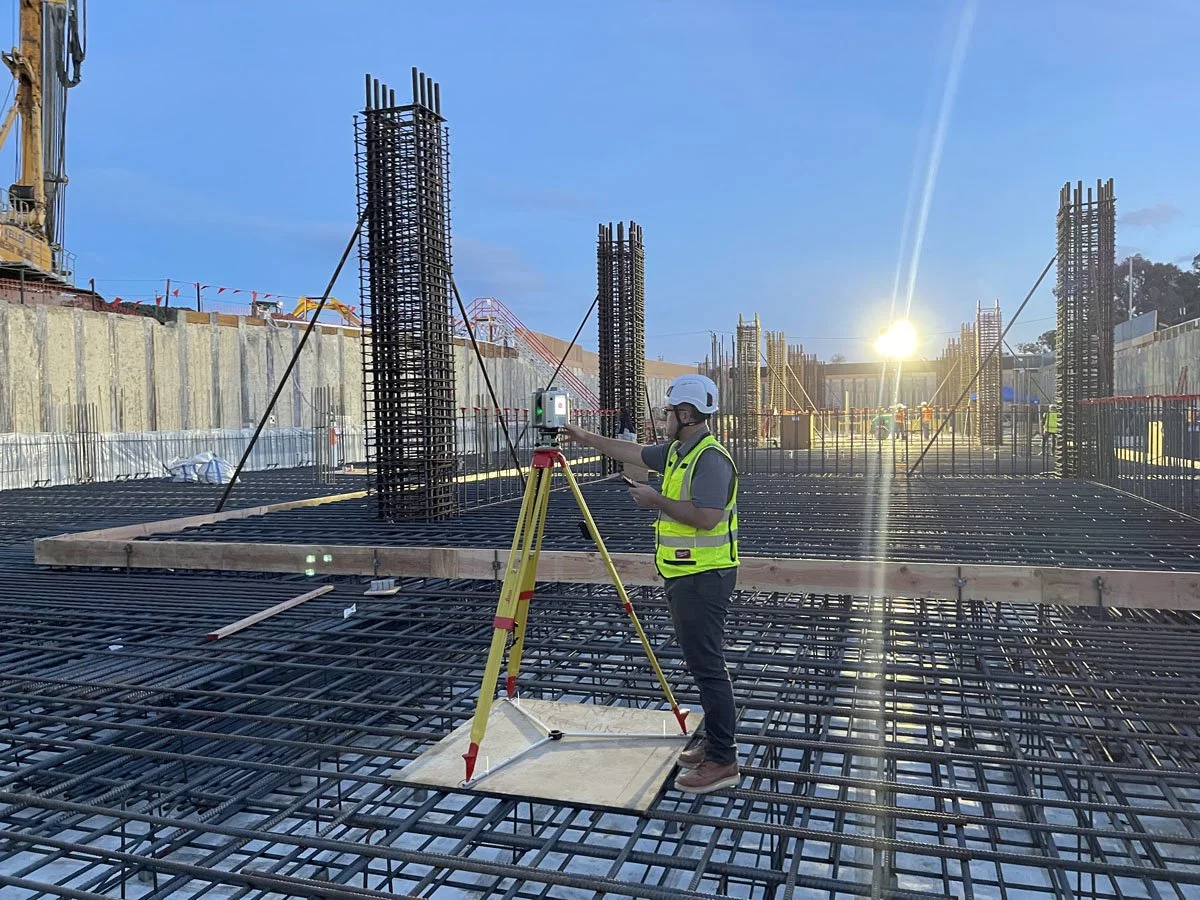
At the Millbrae Station project, Truebeck Construction used laser scanning prior to a major concrete pour to verify vertical dowel placement and generate accurate concrete volume calculations. These scans helped the team detect a critical alignment issue and refine material estimates before the pour began.
VERIFYING CRITICAL REBAR PLACEMENT
Truebeck performed the first scan late Thursday afternoon, with the concrete pour scheduled to begin at 2:00 a.m. on Saturday.
The scan captured the exact location of each vertical dowel installed on site. This point cloud data was then overlaid with the structural plans to confirm that each set of dowels aligned with the center of its corresponding column.
During the review, the team discovered that one column’s dowels were offset by approximately 4–6 inches.
Further investigation revealed the cause: the structural drawings showed the column offset from the gridlines, while the rebar shop drawings placed the dowels directly on the grid intersection.
Without the scan, the discrepancy could easily have gone unnoticed until after the concrete pour.
Truebeck explained:
“One thing with concrete is that you only get one shot to do it right, so this was our one shot, and we got it right.”
Because the issue was caught early, the ironworkers were able to move the dowels before the pour.
“We were able to get the iron workers to move the dowels and cast the slab with the dowels in the correct location. Had we not caught it we would have had rework, drill and epoxy work.”
Catching the problem ahead of time prevented costly corrective work and potential schedule delays.
IMPROVING CONCRETE VOLUME ACCURACY
The second scan focused on calculating the most accurate concrete volume for the upcoming pour.
Traditional quantity takeoffs often assume ideal conditions, but real-world construction conditions rarely match those assumptions. Rat slabs and shoring walls are rarely perfectly plumb or level, which can introduce significant errors in volume calculations.
By using laser scan data to measure actual field conditions, the team generated a more accurate estimate.
The original quantity takeoff calculated:
3,278 cubic yards
The scan-based estimate determined the pour would require:
3,340 cubic yards
That level of precision allowed the engineering team to approach the pour with greater confidence.
“It was great to have that dialed in and give our engineer some confidence heading into the pour,” Truebeck said. “It took the guesswork out of it.”
PROJECT IMPACT
Scanning before the pour helped the project team:
Detect a critical rebar placement error
Prevent expensive rework and schedule delays
Generate more accurate concrete volume estimates
Increase confidence for the design and engineering teams
Laser scanning before major concrete pours provides a reliable way to verify field conditions and reduce risk before the point of no return.
Truebeck summarized the value of the process simply:
“It makes everyone look like heroes.”