QUALIFICATIONS
OFFICE LAB CONVERSION
DivcoWest, 550 Terry Francois Blvd
Life Science Facility
San Francisco, CA
CHALLENGE
During the early stages of an office-to-lab conversion project, the construction team began removing the building’s raised access flooring. As the flooring was removed, they discovered the structural slabs were significantly out of level and varied widely in thickness throughout the building.
The deviations were severe enough to raise concerns about both ADA slope compliance and minimum slab thickness requirements for structural loading. These uncertainties created potential risks for the design team, structural engineers, and contractors responsible for the lab conversion.
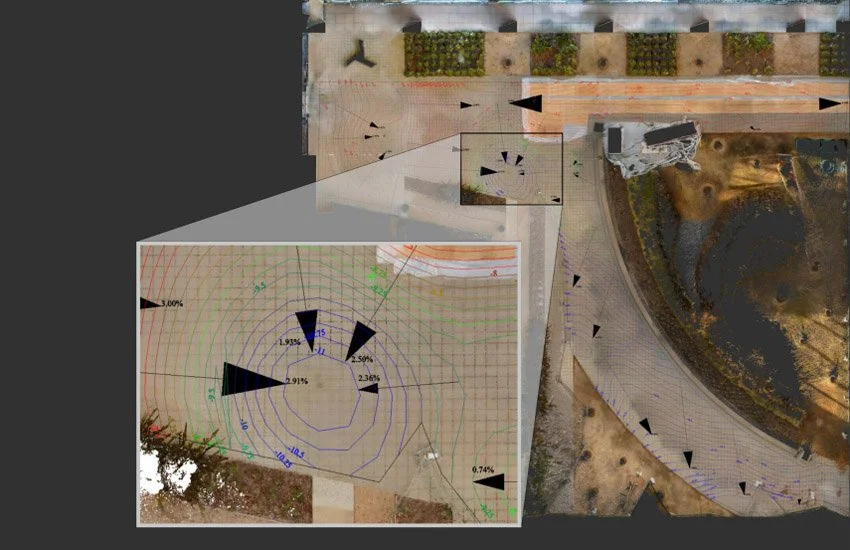
Beyond the building interior, similar concerns existed across the site’s hardscape, where slopes also needed to be evaluated to confirm ADA accessibility requirements were being met.
Without accurate, comprehensive data, the project team lacked the information needed to determine the extent of the issues and develop a clear path forward.
SOLUTION
Siteline deployed laser scanning technology to capture a complete, high-accuracy scan of both the entire building interior and the surrounding site.
Using the scan data, Siteline generated detailed reports including:
Floor flatness analysis
Interior floor slope measurements
Site hardscape slope evaluations
Structural deck thickness mapping
In addition, the same scan data was leveraged to as-built existing utilities, giving the design and construction teams accurate information for coordinating the new laboratory infrastructure within the building.
VALUE
The resulting reports provided the project team with the actionable insights needed to address the building’s structural and accessibility challenges.
The floor flatness and slope reports allowed the team to quickly identify areas that did not meet ADA requirements and determine the necessary corrections.
Meanwhile, the deck thickness analysis enabled the structural engineer to accurately calculate the allowable loading capacity for each structural bay, ensuring the building could safely support the new laboratory program.
Together, these insights eliminated uncertainty, improved coordination, and helped the team confidently move forward with the lab conversion.